Multiple bookings, single peptides — bookingpeptides
Retatrutide appears in structures of three different hormone receptors. That crowded guest list intrigues me; each engagement has consequences to investigate.
Retatrutide under the electron microscope
The pictures that started this for me were molecular structures. In a cryo-electron microscopy study of retatrutide, the peptide was examined in complexes with GLP-1, GIP and glucagon receptors. These were laboratory structures and cell-signalling experiments, far from a person stepping on a scale. Still, the physical question is wonderful: how can one engineered peptide engage such different partners?
An agonist is a molecule that activates a receptor. Retatrutide has several such engagements in its repertoire. “Triple” describes the range of targets; the structures show the individual receptor complexes. I picture a booking register with several entries for the same name.
The fit is uneven. Against the corresponding native hormones, the study reported relative potency of approximately 8.9× at GIPR, 0.3× at the glucagon receptor and 0.4× at GLP-1R. This uneven distribution delights me. Counting receptors gives only the beginning of the pharmacology.
Receptor register
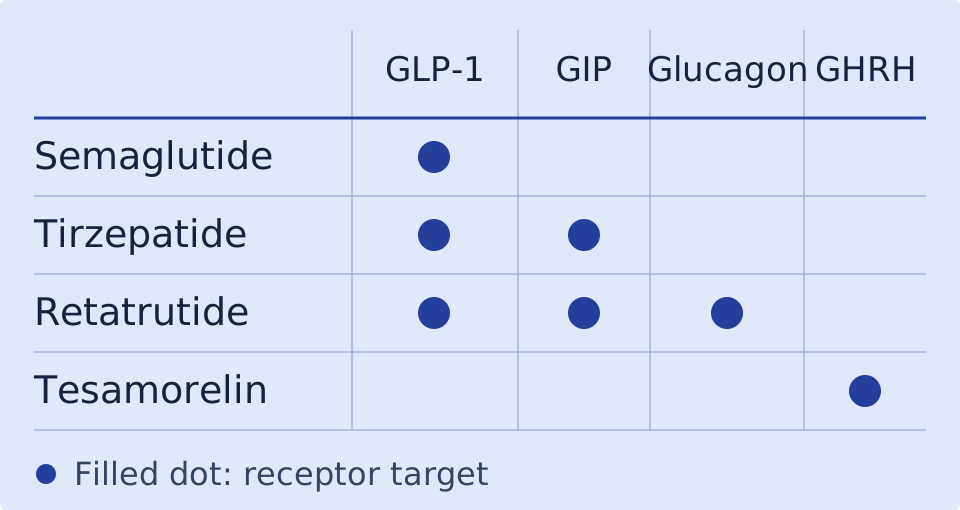
Tirzepatide activates GIP and GLP-1 receptors; semaglutide’s GLP-1 activity reaches appetite circuits in rodents. Tesamorelin stimulates the growth-hormone system through GHRH receptors. Those targets put four peptides into a much more interesting arrangement than a single weight-loss league table.
The name bookingpeptides suits these overlapping engagements. Those engagements send me towards their consequences: which signal is strengthened, where it acts, and which human experiment actually tested the result. The register below is a map of targets. The compound pages follow the consequences.
Human trials
The difference becomes tangible in the direct comparison of tirzepatide and semaglutide. In 751 adults with obesity, mean weight change at 72 weeks was -20.2% with tirzepatide and -13.7% with semaglutide. That comparison earns its place because the treatments met within one trial.
For tesamorelin’s abdominal and liver-fat experiment, the setting was 50 adults with HIV receiving antiretroviral treatment. Its question concerned particular fat deposits. I’d resist turning that into a general promise about body weight. Different receptor, different clinical problem.
The compound pages
- Semaglutide: a single receptor class with effects in several tissues.
- Tirzepatide: the dual GLP-1/GIP peptide, with diabetes and obesity trials read separately.
- Retatrutide: three receptor targets, structural experiments and investigational human results.
- Tesamorelin: the GHRH receptor, insulin sensitivity and the HIV-associated lipodystrophy evidence.
The comparison sets the trial questions beside the receptor register. The questions page deals with names, approvals and the gap between a medicine and laboratory material.